ProGenTomics aims to provide high-quality proteomics services for the biopharmaceutical industry. Our strengths are high-throughput, robust protein analyses combined with timely delivery of results. Do not hesitate to contact us for any protein-based biopharmaceutical analysis services.
Intact protein analysis
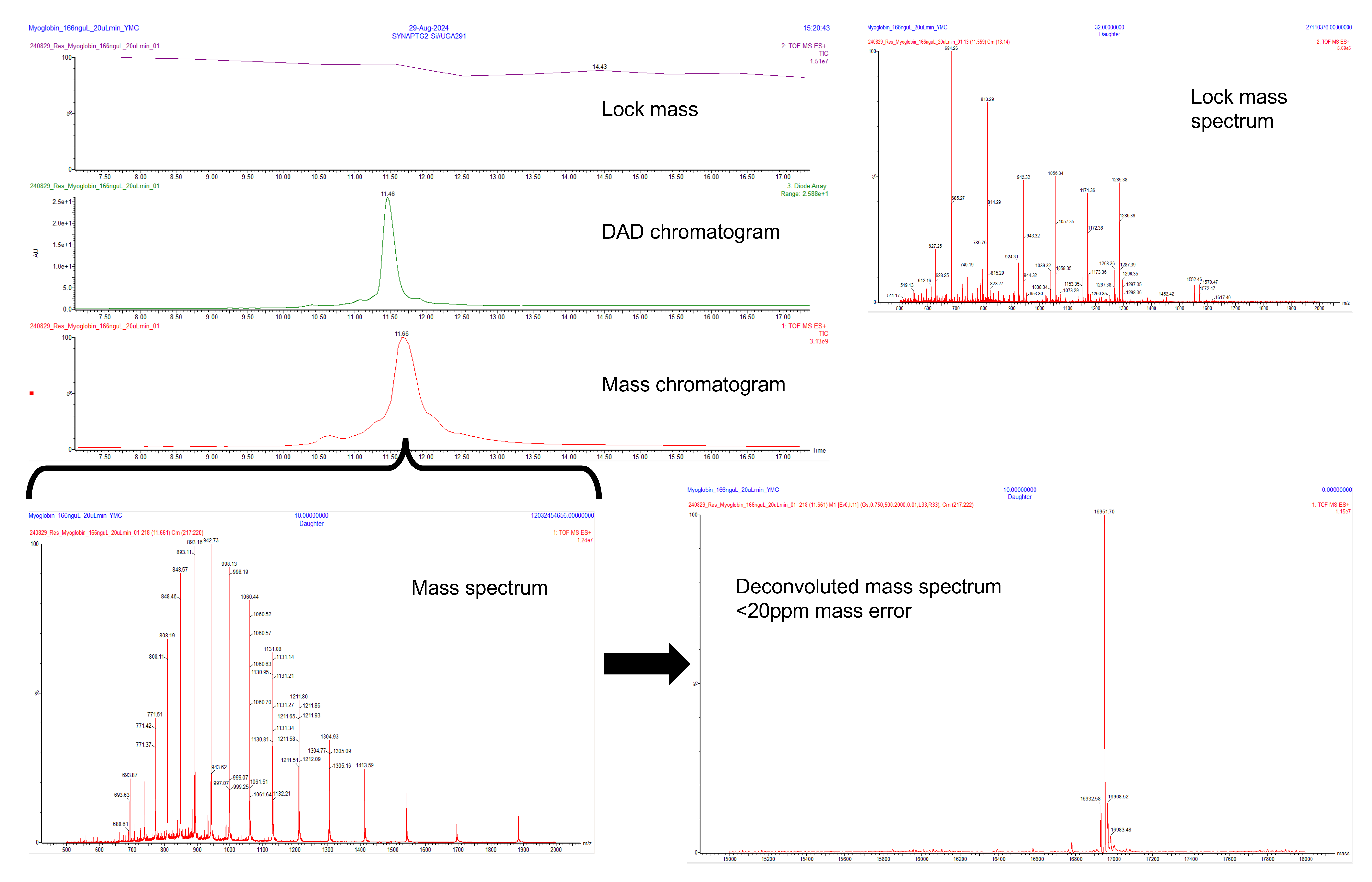
We analyze intact proteins using our Synapt G2-Si coupled to a reversed phase (C4) nanoAcquity UPLC system, equiped with an in-line Diode Array Detector. This enables the analysis of both the intact mass and the UV trace of a certain analyte and its derivatives in a single analysis. The intermittent acquisition of a lockmass calibrant during the analysis ensures a mass accuracy of <20ppm after deconvolution of the charge state envelope.
Peptide mapping (identity)
Peptide mapping is the bottom-up analysis of a protein in order to cover and identify the entire sequence, including modifications. To this end the protein is differentially digested into peptides with up to 4 enzymes, which are analyzed using our state-of-the-art ZenoTOF 7600 mass spectrometer.
Host cell and residual protein analysis
In biologics manufacturing, host cell proteins (HCPs) are a critical quality attribute. These process‑related impurities, originating from the production cell line, can compromise product stability, efficacy, and patient safety if not sufficiently removed. Regulatory agencies require robust detection, identification, and monitoring strategies to ensure product quality.
While ELISA remains a widely used HCP assay, it is inherently limited by antibody coverage — detecting only those proteins the assay antibodies recognize. This means potentially important impurities can go unnoticed.
At ProGenTomics, we use bottom‑up liquid chromatography–mass spectrometry (LC‑MS) to deliver unbiased, high‑resolution HCP analysis throughout your bioprocess.
Our workflow
- Protein digestion – The complex mixture of process proteins is enzymatically digested into peptides.
- Peptide separation – High‑performance LC resolves peptides, reducing complexity before MS detection.
- High‑resolution MS analysis – State‑of‑the‑art mass spectrometers identify and quantify peptides with unmatched sensitivity and accuracy.
Your advantages
- Detect hundreds of HCPs in a single run — including low‑abundance species missed by ELISA.
- Track changes in HCP profiles across purification and scale‑up steps.
- Guide process optimization with actionable, data‑driven insights.
Whether for cell line development, process optimization, comparability studies, validation, or regulatory submissions, our bottom‑up LC‑MS platform provides the detailed, actionable HCP profile you need to de‑risk your biologics pipeline.
Purification process monitoring
When dealing with biological resources such as plasma, the purification process is a pivotal part of the biopharmaceutical production process. We can quantitatively map all proteins present during the different steps of a purification process using our automated bottom-up LC-MS workflows.
Potency assays
We provide (targeted) LC-MS-based assays to monitor the expression profiles of RNA-based therapeutics.